AI powered Procurement
Don't automate the workflow simply because AI can. Redesign the workflow around what AI is uniquely good at while keeping people in control.
00

problem
Procurement is complex, fragmented, and highly manual. Procurement teams spend significant time: -Creating and managing RFPs - Answering repetitive supplier questions - Comparing supplier bids - Checking contracts and compliance - Moving information between disconnected systems At the same time, procurement decisions involve regulatory, financial, and operational risk.
solution
A multi-agent procurement system Instead of a single general-purpose AI, the solution uses specialised agents that work together. This allows each agent to operate within a defined scope while contributing to a larger procurement workflow.
GenAI Procurement
Designing and building a multi-agent AI system for enterprise procurement
Role: UX / Service Designer · GenAI Engineer
Focus: AI Product Design · Service Design · GenAI Engineering · AI Governance
Tech: React · Flask · Azure AI Foundry · LangChain · RAG · Vector Search
Outcome
The project resulted in a working multi-agent AI prototype that demonstrates how procurement workflows could move from:
Manual → Assisted → Intelligent
without removing humans from critical decisions.
More importantly, the project helped me develop an approach to AI product design that connects UX, service design, AI engineering and AI governance.
What I learned
AI changes the role of the designer.
Designing an AI product isn't only about designing screens.
It requires understanding:
People → Service → AI behaviour → Data → Engineering → Governance
My role increasingly sits at the intersection of these disciplines.
The takeaway
Don't automate the workflow simply because AI can.
Redesign the workflow around what AI is uniquely good at—while keeping people in control.
The approach
I approached the problem as a service transformation, rather than simply adding a chatbot.
01 — Understand the service
Mapped the end-to-end procurement journey and identified high-friction activities where AI could provide meaningful value.
02 — Identify AI opportunities
Four high-value agent opportunities emerged:
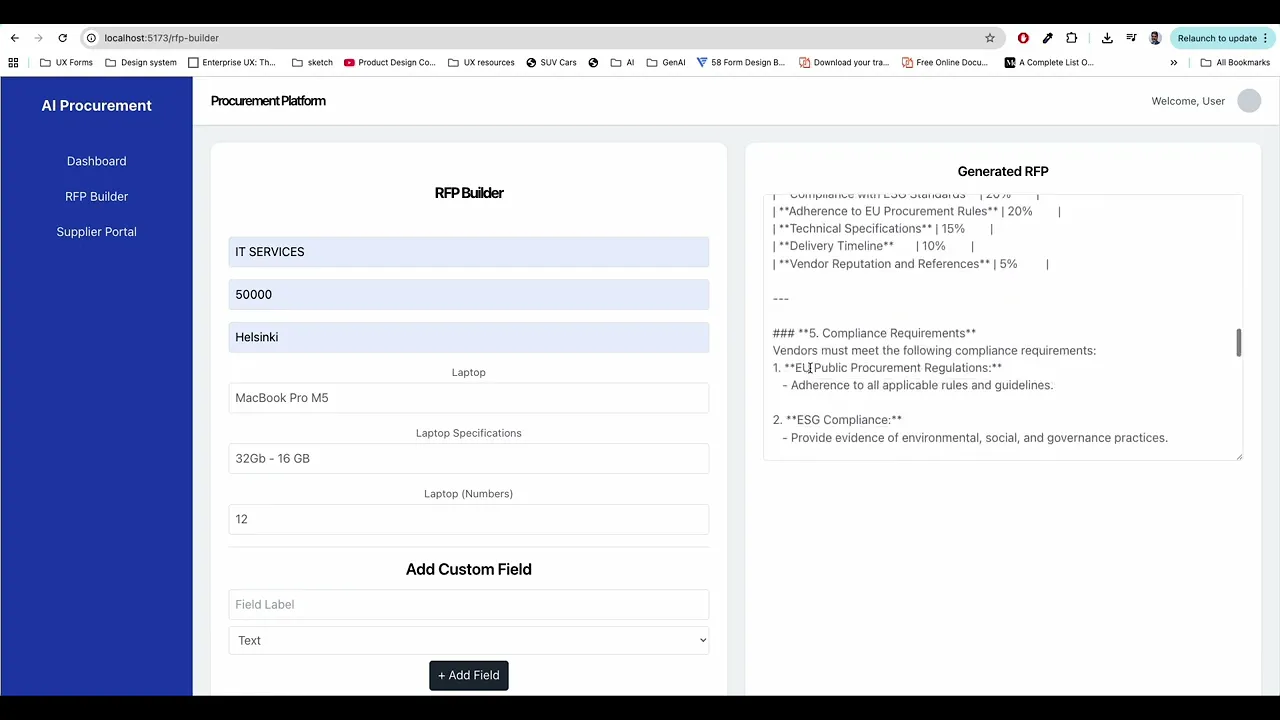
RFP Agent
Creates compliant RFPs from procurement requirements.Supplier Q&A Agent
Handles repetitive supplier questions using organisational knowledge.Evaluation Agent
Helps compare suppliers against multiple criteria.Contract Agent
Assists with contract drafting and compliance.
03 — Design the human–AI workflow
The agents were designed as collaborators, not autonomous replacements.
The system provides:
AI recommendation → Evidence → User review → Human decision
This keeps people in control of high-impact decisions.
From prototype to working system
I didn't stop at the interface.
I built a working technical prototype to understand the practical constraints of the AI experience.
Architecture
React
Frontend
↓
Flask
Backend / API
↓
Azure AI Foundry
AI orchestration
↓
Specialised agents + RAG
↓
Vector Search / enterprise data
↓
Structured AI output
This allowed me to validate both the UX and the underlying AI workflow.
AI engineering
The prototype explored:
Multi-agent orchestration
RAG and vector search
Structured Prompts
Structured outputs
Agent memory
Tool and knowledge retrieval
Prompt and response validation
Error and fallback handling
Agent evaluation
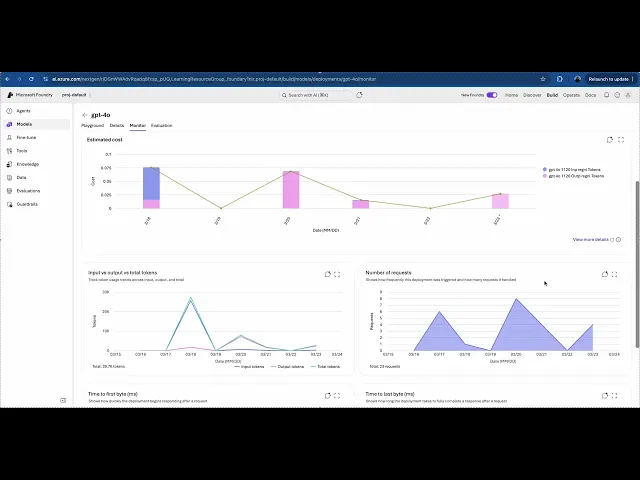
Observability and feedback loops
Responsible AI by design
Procurement is a high-impact environment, so governance was considered alongside the product design. Key considerations included:
Transparency — users should understand AI-generated recommendations.
Human oversight — important decisions remain with people.
Data privacy — supplier and procurement information must be protected.
Auditability — AI decisions and actions should be traceable.
Bias & fairness — supplier recommendations should be evaluated for unintended bias.
year
2026
timeframe
16 days
tools
React · Flask · LangChain · RAG · Vector Search . Azure AI
category
Personal Project